
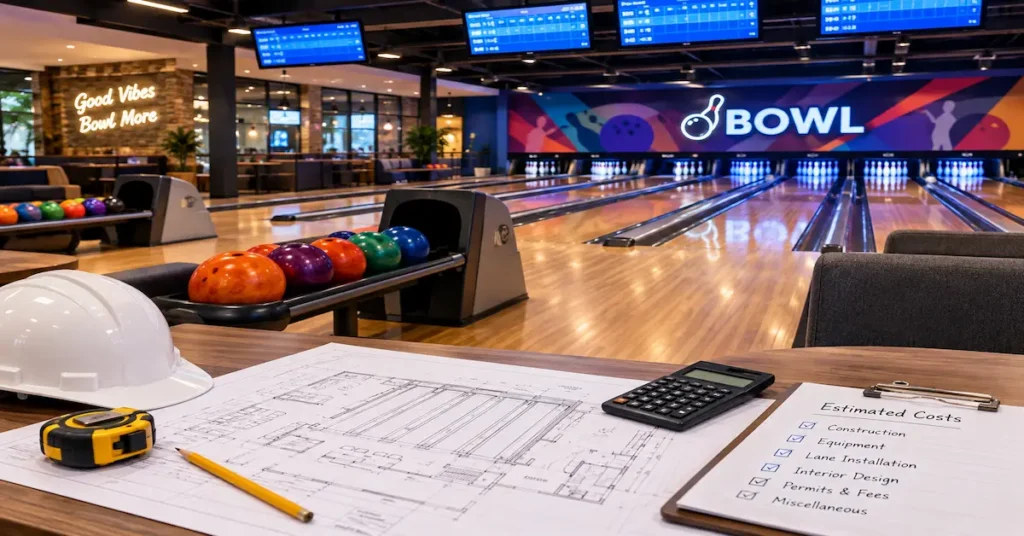
To build a commercial bowling alley in 2026, expect a total investment between $500,000 and $8 million. A home bowling setup runs $35,000 to $500,000. The gap comes down to lane count, new build versus retrofit, and whether the venue includes a restaurant, bar, or arcade.
This guide breaks down every budget category the way a project estimator builds a real bid, line by line, using 2026 material rates, current supplier pricing, and RSMeans regional labor data.
| Project Type | 2026 Total Investment |
| Mini home bowling lane (2 short lanes) | $35,000 – $90,000 |
| Single regulation home lane | $75,000 – $175,000 |
| Small commercial venue (8 lanes) | $1M – $3M |
| Mid-size commercial center (12 lanes) | $2M – $5M |
| Large commercial center (24 lanes) | $4M – $8M+ |
6 Cost Categories That Make Up a Bowling Alley Budget
Every bowling alley budget breaks into the same 6 spending categories. On a recent 16-lane entertainment center project in Texas, a pre-construction review by a commercial estimation firm caught $180,000 in scope gaps between the architect’s drawings and the contractor’s bid, gaps that would have surfaced as change orders mid-build. Mapping each of these categories to real local costs before committing capital prevents exactly that kind of overrun.
Land and Location
Land acquisition runs $500,000 to $2,000,000 for a commercial parcel. Suburban corridors near shopping centers and restaurant clusters attract the best mix of affordability and foot traffic.
Leasing avoids the upfront purchase. Commercial rents average $15 to $40 per square foot per year, roughly $18,750 to $50,000 monthly for a 15,000-square-foot venue.
Each regulation tenpin lane needs approximately 88 to 100 feet of length and 14 feet of width. According to Murrey Bowling, operators should budget roughly 1,000 square feet per lane total, and the bowling area should not exceed 50% of the building footprint.
Building and Structural Work
New builds run $150 to $300 per square foot based on RSMeans data. Retrofitting an existing space drops that to $50 to $200 per square foot, which is why most first-time operators choose conversion.
Foundation: Bowling lanes demand an exceptionally flat slab. Standard slab-on-grade runs $8 to $18 per square foot, with a 15–20% premium on reinforced pin deck and pinsetter zones. A professional concrete estimation before pouring prevents a $50,000 surprise mid-project.
HVAC: Lane oil behaves differently at different humidity levels. Competitive bowlers notice within a few frames. Budget $15,000 to $40,000 per lane for HVAC and dedicated dehumidification. A bowling facility needs tighter climate control than standard retail, closer to a data center than a clothing store.
Bowling Hardware and Lane Systems
The full gear package runs $30,000 to $80,000 per lane. Per-lane pricing drops at higher lane counts because shared infrastructure spreads across more units.
| Component | Per-Lane Range | What Drives the Price |
| Lane surface (synthetic) | $20,000 – $60,000 | Brand, overlay quality, UV resistance |
| Lane surface (hardwood) | $40,000 – $100,000 | Wood species, kiln-drying, labor |
| String pinsetter | $10,000 – $20,000 | Manufacturer, USBC certification |
| Mechanical pinsetter | $25,000 – $50,000 | Brand (Brunswick, AMF), new vs refurbished |
| Scoring and displays | $5,000 – $20,000 | Touchscreen size, POS integration |
| Ball return | $3,000 – $8,000 | Above-ground vs underground |
| Bumpers, gutters, oiling | $3,000 – $10,000 | Automatic bumpers, lane machine brand |
String vs mechanical pinsetters: String systems use a cable-based mechanism that is simpler, quieter, and needs only $200–$400 in annual maintenance per lane. Mechanical pinsetters demand $1,500–$3,500 in yearly upkeep plus a certified bowling mechanic on staff or retainer. The BPAA has noted increasing adoption of string systems across new U.S. builds because the lower maintenance improves operating margins.
Synthetic vs wood lanes: Synthetic resists wear longer and requires less frequent resurfacing, the default choice for entertainment-focused venues. Wood delivers the traditional feel competitive bowlers prefer, but needs periodic sanding and refinishing that adds to operating costs over time.
Permits, Licensing, and Code Compliance
Budget $20,000 to $80,000 total for building permits ($1,000–$10,000), ADA modifications ($15,000–$50,000), fire marshal inspection, health department permits, liquor licensing, and commercial insurance.
Permitting takes 2–4 months in Texas and Florida, but stretches to 6–12 months in California and New York. Skipping compliance planning is one of the most common estimating mistakes for entertainment venues.
Bar, Kitchen, and Food Service
Food and beverage generates 30–40% of total income for a well-run bowling center, according to BPAA benchmarking. A full build-out adds $100,000 to $500,000.
- Bar: Cellar with air conditioning (11–13°C), modular front-bar units, back-bar décor, and draft system. A beverage partner typically provides chillers, pumps, and tap lines at no cost as part of the supply agreement.
- Kitchen: Commercial-grade extraction and ventilation (legal requirement), durable all-day-use appliances, and storage sized to the delivery cycle. Keep the menu small. A complicated menu increases size, staffing, and waste without proportional revenue.
- Operator lesson: Never position the kitchen as “open” or “show” in a leisure venue. Unlike restaurants with fixed service periods, a bowling kitchen receives orders continuously during peak hours with no reset windows.
Furnishing, AV, and Interior Fit-Out
Furniture, décor, lighting, flooring, signage, AV, and Wi-Fi add $50,000 to $200,000 for a mid-size center. A detailed finishes estimation helps allocate this budget across individual line items before vendors start quoting.
- Signage ($5,000–$50,000) may need separate planning permission.
- Commercial Wi-Fi is essential for POS and scoring. Residential-grade hardware cannot handle a busy venue’s concurrent connections.
- The reception desk ideally extends from the bar counter to reduce off-peak staffing.
- Party rooms for private events generate high-margin bookings.
Cost Breakdown by Lane Count
8-Lane Venue
Fits boutique concepts and sports bars. Shared infrastructure (mechanical room, scoring server, HVAC) represents a larger share of total cost at this scale. An 8-lane venue runs with 3–5 employees per shift, keeping first-year payroll manageable.
12-Lane Venue
The sweet spot for malls, resorts, and mid-size family entertainment centers. At 12 lanes, the venue can host 4–6 league teams simultaneously, run birthday parties on one end, and book corporate events for groups of 40–60. That flexibility supports multiple revenue streams without needing a 30,000-square-foot building.
24-Lane Center
A full-scale operation with a 20,000- to 40,000-square-foot footprint. The trade-off: break-even stretches because the center needs consistent weekday traffic, strong league programs, a food and beverage operation at scale, and a robust event booking pipeline.
Home Bowling Alley Costs
Single Regulation Lane
The room needs 88–100 feet of clear length, which limits installation to custom homes or very large basements. Room build-out (floor prep, acoustics, electrical, ventilation) adds $20,000 to $120,000 on top of gear cost. A residential estimation scoped to the lane room helps homeowners budget the build-out separately from the bowling hardware.
Mini and Duckpin Home Lanes
Mini and duckpin formats use shorter lanes with smaller balls and lighter pins, making them practical for basements and recreation rooms without major structural work. Home bowling is a lifestyle purchase. In homes under $1.5 million, the addition has a neutral to minor resale impact.
Bowling Formats Beyond Standard Tenpin
- Duckpin: 9-meter lane, 1.25 kg balls, $14,000–$26,000 per lane. Suits bars, hotels, and social venues where tenpin is impractical.
- Medium: Adjustable 9.6–18-meter lanes. Balances duckpin compactness with a more substantial bowling feel, practical for hotels and leisure centers.
- Mini: Starts at $11,000–$20,000 per lane. Targets family entertainment centers and children’s zones.
Choosing a compact format over tenpin reduces gear cost by roughly a third, making format selection one of the highest-impact budget decisions.
Bowling Alley Staffing and Pre-Opening Costs
- Staff hiring and training: ~$50,000 for recruitment, two weeks of operational orientation, and initial payroll
- Bar and kitchen stocking: ~$30,000 upfront inventory, including slow-moving display bottles
- Marketing and PR launch: Minimum $50,000, varies by campaign approach.
- Working capital reserve: 3–6 months of rent, payroll, and utilities before revenue stabilizes
A professional estimating firm helps create these projections on verified numbers rather than assumptions.
Monthly Running Costs of a Bowling Alley
Monthly fixed overhead runs $30,500 to $88,000 depending on facility size.
| Category | What It Covers |
| Facility (40–50%) | Rent or mortgage, maintenance, property taxes |
| Staffing (20–30%) | Wages, payroll taxes, benefits |
| Utilities (8–12%) | Electricity, water, HVAC |
| Insurance (3–5%) | General liability, liquor liability, property |
| Marketing (3–5%) | Digital ads, local promotions |
| Maintenance (2–4%) | Lane resurfacing, mechanical parts, repairs |
How to Lower the Total Project Cost
- String pin systems: The upfront savings are significant, and lower annual maintenance compounds over every year of operation
- Compact formats: Duckpin or mini bowling suits social entertainment venues and cuts gear cost by roughly a third
- Retrofit over new build: Structural savings from converting an existing building can offset the price of a higher-quality gear package.
- Certified used scoring and furniture: Source refurbished systems where condition meets commercial standards
- Phased amenity rollout: Open with core lanes and a basic bar, then expand kitchen and arcade once revenue confirms demand.
- Professional quantity takeoff: Accurate material lists prevent over-ordering and catch scope gaps before they become change orders
Revenue, ROI, and Market Outlook
Revenue per square foot ranges from $100 to $250 annually across lane rentals, food and beverage, event bookings, arcade gaming, and league fees.
According to Market.us, the global bowling centers industry was valued at $18.3 billion in 2024 and is projected to reach $25.6 billion by 2034 (3.4% CAGR). Well-capitalized operators typically reach break-even within 12–18 months.
According to the AACE International Cost Estimate Classification System (RP 56R-08), moving from a Class 5 conceptual estimate (±30–50% accuracy) to a Class 1 definitive estimate (±3–10%) before breaking ground dramatically reduces overrun risk. 247 Estimation applies this framework to every commercial recreation project.
Timeline for Build and Installation
Ground-up builds take 12 to 24 months from site selection to opening. Retrofits compress that to 6 to 14 months. Custom pinsetters carry 3–4-month lead times, so ordering before the build begins protects the schedule. Hiring a general contractor with bowling-center experience avoids underestimating lane flatness tolerances and pin-machine electrical requirements.
Financing and Payment Structures
Common paths include SBA 504 or 7(a) loans, commercial mortgages, hardware-specific financing through the lane manufacturer, and lease-to-own arrangements. Finance payments may be tax-deductible as a business expense.
Some manufacturers, including MJH Events (UK) and Murrey Bowling (U.S.), offer in-house financing that bundles gear, installation, scoring, and training into a single monthly payment.
Frequently Asked Questions
Can I convert a warehouse or retail building into a bowling alley?
Yes, most first-time operators do. Key requirements: 10–12 feet clear ceiling height, 88+ feet uninterrupted lane depth, adequate electrical capacity, and a floor slab meeting flatness tolerances. Vacant big-box retail stores and industrial warehouses are the most common conversion candidates because they already have open floor plans, high ceilings, and parking infrastructure in place.
What is the most expensive single component?
For new builds, the building shell. For retrofits, the mechanical pinsetter, the priciest single hardware line item by a wide margin. Operators can reduce this cost significantly by choosing string pinsetters, which deliver comparable gameplay at a fraction of the upfront and maintenance expense.
Do I need a liquor license?
Only if serving alcohol. The price and timeline vary widely by state and municipality. In some jurisdictions, the license itself costs more than the entire permit budget, so factoring it into the financial plan early avoids cash flow surprises before opening day.
How many employees does a bowling alley need?
Staffing scales directly with lane count and amenity scope. Venues with food service and event coordination need roughly double the headcount of a lanes-only operation. Modern scoring and reservation systems reduce front-desk staffing needs, but kitchen and bar roles cannot be automated in the same way.
String vs mechanical pinsetters: what is the difference?
String systems use cables to reset pins. Simpler, quieter, cheaper to maintain. Mechanical systems use arms, belts, and conveyors. Traditional pin action but higher upfront and ongoing costs. Most new entertainment-focused venues choose string because the maintenance savings compound every year, while high-volume league centers may still prefer mechanical for the authentic pin action competitive bowlers expect.
Is a home bowling lane worth it?
As a lifestyle purchase, yes. As a financial investment, the return is limited to homes valued above $2 million. Families who use the lane regularly get years of entertainment value without per-game fees, travel time, or waiting for open lanes at a commercial center.
Where can I get an accurate bowling alley estimate?
247 Estimation provides trade-sorted cost estimates for commercial bowling projects using RSMeans zip-code pricing, delivered within 24–48 hours. Each estimate covers all CSI divisions and arrives as an editable Excel file with color-coded PDF markups ready for contractor bidding.