
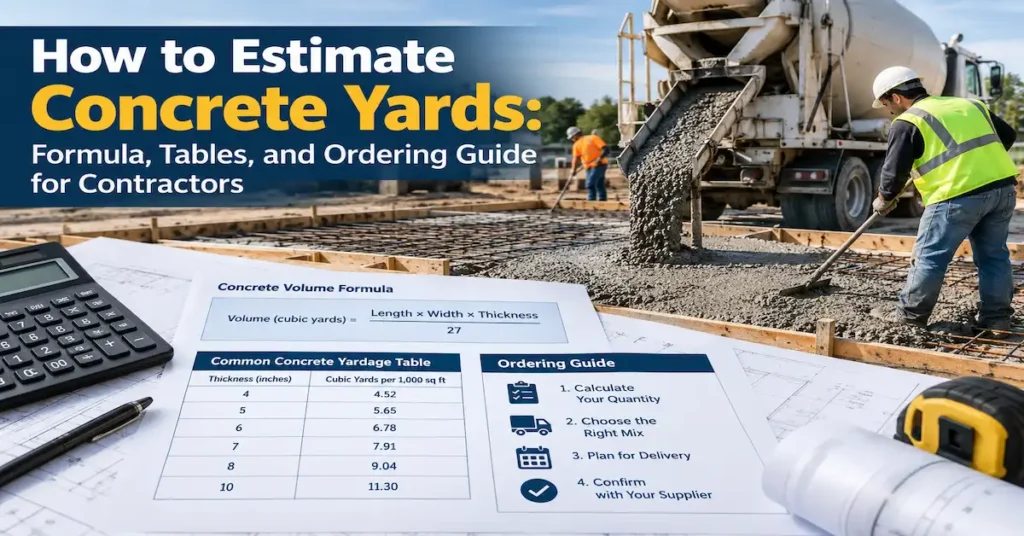
To estimate concrete yards, multiply length (ft) × width (ft) × thickness (ft) and divide by 27. A 12 × 30-foot driveway at 4 inches thick works out to 12 × 30 × 0.333 ÷ 27 = 4.44 CY. Add 10% for waste, round up to 5.0, and that is the number you call into the batch plant. Every ready-mix supplier in the United States prices and delivers by the cubic yard, one yard equals 27 cubic feet and weighs roughly 4,050 pounds per ASTM C138 density standards.
Getting this number wrong costs real money in both directions. A short pour stalls the crew, risks a cold joint where fresh material meets partially cured concrete, and triggers a return-trip fee between $200 and $500. An over-order at today’s per-yard rates sends $300+ worth of material to the washout pit. The math takes 30 seconds. The consequences of skipping it last the life of the slab.
The Core Formula (Two Versions)
The standard version converts everything to feet first:
(Length × Width × Thickness in feet) ÷ 27 = CY
The shortcut skips the inch-to-foot step for thickness:
(Length ft × Width ft × Thickness in inches) ÷ 324 = CY
The number 324 is just 27 × 12. Both produce identical results. Most field estimators use the shortcut because thickness is almost always spec’d in inches, 4″ for a patio, 6″ for a loaded driveway, 8″ for a commercial pad, and converting to decimal feet on a phone calculator introduces rounding slip.
Worked Example
A garage apron measures 16 feet wide × 20 feet long at 5 inches thick.
16 × 20 × 5 ÷ 324 = 4.94 CY → add 10% → 5.43 → round to 5.50 CY order
That rounding matters. Batch plants dispatch in quarter-yard increments, and falling a quarter-yard short mid-pour with a crew standing on wet concrete turns a simple math step into an expensive problem. Round up to the next 0.25 always.
Calculating Volume for 6 Common Shapes
Every pour on a job site reduces to basic geometry. The shape determines which measurements you take; the ÷ 27 conversion stays the same.
Rectangular Slabs
Measure the long side, the short side, and the thickness. For L-shaped or T-shaped pours, break the area into rectangles, calculate each one separately, and sum the volumes. Do not average the dimensions across an irregular shape, that hides the extra material trapped in the wider sections.
Square Footings
Side × side × depth ÷ 27. A 24-inch square footing at 12 inches deep: 2 × 2 × 1 ÷ 27 = 0.148 CY per footing. Multiply by the footing count. A foundation plan with 20 spread footings needs 2.96 CY before overage, and footing pours carry higher waste (10–15%) because over-excavation is almost unavoidable.
Round Columns and Piers
π × radius² × height ÷ 27. Sonotube forms come in standard diameters (8″, 10″, 12″, 16″, 18″, 24″), so keep a lookup handy rather than punching pi every time. A 12-inch tube at 36 inches deep: 3.14 × 0.5² × 3 ÷ 27 = 0.087 CY. Twenty piers across a deck foundation total 1.74 CY.
Continuous Strip Footings
Linear feet × width (ft) × depth (ft) ÷ 27. A 140-foot perimeter footing at 16″ wide and 12″ deep: 140 × 1.333 × 1.0 ÷ 27 = 6.91 CY. Always walk the full perimeter on site, architectural plans sometimes omit jogs, pilasters, and grade beam offsets that add 5–8% to the linear footage.
Foundation Walls
Length × height × wall thickness ÷ 27. A 60-foot wall at 8 feet tall and 8 inches thick: 60 × 8 × 0.667 ÷ 27 = 11.85 CY. On foundation pours, estimate footings, walls, and the slab separately, then combine for the truck count, never lump them into one rectangle. When poured walls sit alongside masonry block work, estimate those volumes as separate line items.
Steps and Staircases
Treat each step as its own small rectangle. A step 36″ wide × 12″ deep × 7″ tall: 3 × 1 × 0.583 ÷ 27 = 0.065 CY. Five steps = 0.325 CY. Add the top landing as a separate slab calculation. Staircase pours are small-volume work where bagged mix sometimes makes more sense than calling a truck.
Quick-Reference Yardage Table
All values below assume 4-inch thickness before waste allowance.
- 10 × 10 ft → 1.23 CY
- 10 × 12 ft → 1.48 CY
- 12 × 12 ft → 1.78 CY
- 12 × 16 ft → 2.37 CY
- 16 × 16 ft → 3.16 CY
- 16 × 20 ft → 3.95 CY
- 20 × 20 ft → 4.94 CY
- 20 × 24 ft → 5.93 CY
- 20 × 30 ft → 7.41 CY
- 24 × 24 ft → 7.11 CY
- 24 × 30 ft → 8.89 CY
- 30 × 30 ft → 11.11 CY
- 30 × 40 ft → 14.81 CY
- 40 × 40 ft → 19.75 CY
- 40 × 60 ft → 29.63 CY
Need a different thickness? Multiply any 4-inch value by 1.25 for 5 inches, or by 1.50 for 6 inches. The table saves time on bid day, but always verify against the actual site dimensions, plans and field measurements disagree more often than most contractors admit.
Coverage Rates: Area Per Yard at Each Thickness
When you know the square footage but want a fast yardage estimate without pulling up the formula, use coverage rates.
At 4 inches, one yard covers 81 sq ft. At 5 inches, that drops to 64.8 sq ft. At 6 inches, 54 sq ft. At 8 inches, 40.5 sq ft.
A 300-sq-ft patio at 4 inches: 300 ÷ 81 = 3.70 CY. Add the waste buffer, round to 4.25, and call the plant. Coverage rates also help estimate material cost per square foot, divide the current per-yard rate by the coverage number. At standard residential pricing, a 4-inch slab runs roughly $2/sq ft in concrete alone, before labor, rebar, gravel base, or forms touch the budget.
Waste Factor: The Number You Cannot Skip
Three field conditions guarantee that every pour consumes more material than the formula predicts.
The subgrade is never laser-flat. Even with proper grading, low spots across a 400-sq-ft slab can absorb an extra tenth of a yard that no plan-based calculation captures. Form boards, especially 2×4 stakes on 20-foot runs, bow outward under hydrostatic pressure. A quarter-inch of flex across both sides of a 20-foot pour widens the slab just enough to swallow material. And placement losses (chute splatter, drum residue, wheelbarrow coating, hose priming) eat another 1–3% of the delivered load.
The rule of thumb experienced contractors follow:
- Flat rectangular slabs on firm ground: 5%
- Slabs with thickened edges or monolithic turn-downs: 7–10%
- Footings, walls, piers, and any pour with open-earth forms: 10–15%
A half-yard shortage halts the entire pour. The crew stands idle, the already-placed material starts to set, and the batch plant charges a return-trip fee that dwarfs the cost of the extra half-yard. Ordering one more quarter-yard at the standard rate is always cheaper than dealing with the callback.
Contractors who track their actual vs. estimated yardage across 10+ pours find that the real waste percentage stabilizes around 7–8% for typical residential flatwork, close to the National Ready Mixed Concrete Association’s recommended planning buffer. A reliable concrete estimation accounts for this buffer before the order reaches the batch plant.
Choosing the Right PSI Mix
PSI (pounds per square inch) measures the compressive strength concrete reaches after 28 days of curing. Each grade carries a different price per yard and serves a specific load condition.
- 2,500 PSI: Handles interior slabs and light walkways with no vehicle traffic. Many suppliers have stopped stocking this grade entirely because demand has shifted to stronger mixes.
- 3,000 PSI: Serves as the standard residential workhorse for patios, sidewalks, and standard driveways. When a supplier quotes a per-yard rate without specifying strength, they almost always mean this grade.
- 3,500 PSI: Covers heavier residential driveways and light commercial walks. The price bump over 3,000 is modest, typically $5–$10/yard, but the strength gain is meaningful for any slab that sees regular truck traffic.
- 4,000 PSI: Falls into commercial territory, structural footings, foundations, ICF walls, retail parking lots. Expect to pay $10–$20/yard above the 3,000 rate. On every commercial job, read the structural drawings before quoting because the PSI spec sits on the slab schedule.
- 4,500–5,000 PSI: Goes into parking garages, high-load warehouse floors, and engineered structural members. Premium above standard runs $15–$30/yard.
- 6,000+ PSI: Reserved for specialty work, post-tensioned slabs, high-rise structural elements, and industrial applications where a structural engineer specifies the mix design by number.
Admixtures That Change Cost
Beyond PSI, admixtures change both the price and the pour behavior. Polypropylene or steel fiber ($8–$12/yard) replaces wire mesh and distributes reinforcement more uniformly through the slab. Cold-weather accelerator ($3–$8/yard) speeds the set when temperatures hover near 40°F. Hot-weather retarder ($4–$8/yard) slows the cure so the finishing crew can work a full slab before the surface stiffens. Air entrainment, mandatory in freeze-thaw climates, is usually bundled into the quoted price, but confirmed before ordering.
Full Cost Breakdown for a Concrete Pour (2026)
A residential patio measuring 16 × 20 feet at 4 inches thick (3.95 CY before waste, 4.50 CY ordered) breaks down roughly like this:
- Ready-mix concrete: Costs $160/yard × 4.50 = $720. This is the batch-plant invoice, material and standard delivery within 20 miles.
- Gravel base and compaction: Runs $1.50/sq ft × 320 sq ft = $480. Four inches of compacted crushed stone under the slab prevents settling and improves drainage.
- Formwork: Comes to $0.60/sq ft = $192. Covers lumber, stakes, form oil, and the labor to set and strip.
- Wire mesh reinforcement: Adds $0.25/sq ft = $80. Includes chairs to hold the mesh at mid-slab height.
- Finishing labor: Totals 0.65 crew-hours/yard × 4.50 × $40 loaded rate × 3-person crew = $351. Decorative finishes carry a premium because the additional tooling passes extend the crew’s on-slab time.
- Saw-cut control joints: Averages $2.50/linear foot × 3 cuts = $120. Wet-saw rental for a half day if the contractor does not own one.
Total installed estimate: ~$1,943, or about $6.07/sq ft for a basic broom-finish patio at 3,000 PSI.
This example excludes permits, demolition of existing surfaces, grading beyond the slab footprint, and overhead/profit markup (typically 15–25% for residential). Direct material, labor, equipment, subcontractor, and contingency costs all feed into the final proposal number, and missing any single category is how bids go from profitable to break-even. 247 Estimation accounts for each of these categories in every takeoff package to prevent line-item gaps.
7 Mistakes That Inflate Concrete Project Costs
- Mixing measurement units: Entering length in feet and thickness in raw inches, without dividing by 12, produces a volume 12× too high. Batch plants report receiving orders for 50+ yards on residential patios more often than the industry likes to admit.
- Skipping the waste buffer: Running short by even half a yard halts the pour, idles the crew, and forces a return trip that costs far more than the buffer would have. The waste factor section above covers the exact percentages by pour type.
- Measuring round formwork from the inside: Column and pier calculations need the full outer diameter of the Sonotube or form, not the intended finished dimension. The form wall itself displaces concrete.
- Defaulting to 3,000 PSI without reading the spec: Commercial projects carry specific mix-design requirements. Discovering mid-pour that the engineer specified 4,000 PSI means rejecting the truck, re-ordering, and absorbing the wasted load.
- Ignoring the short-load surcharge: Small orders below the supplier’s minimum-load threshold carry a per-delivery fee that can push the effective per-yard rate 50–100% above the listed price.
- Leaving rebar and mesh out of the bid: The batch plant sells concrete. Reinforcement is a separate purchase, a separate labor line, and a separate material delivery. It never appears on the ready-mix invoice.
- Assuming truck access without a site walk: A locked gate, a narrow side yard, power lines at chute height, or rain-softened ground can force a pump truck, adding $700–$2,500 to the project cost, which was never in the quote.
Frequently Asked Questions
How do I convert cubic feet to cubic yards?
Divide the total cubic feet by 27. A volume of 133 cubic feet converts to 133 ÷ 27 = 4.93 CY.
How many 80-lb bags fill one cubic yard?
Forty-five bags. For 60-lb bags, the count rises to 60. Ready-mix delivery beats bagged mix on cost and consistency for any project above 1.0–1.5 CY.
What does ready-mix concrete cost in 2026?
Standard 3,000-PSI mix averages $160/yard nationally, with a typical range of $140–$195 depending on region, supplier, and admixtures. Delivery within 20 miles is usually included. Saturday and after-hours surcharges add $100–$200.
How much extra should I order beyond the calculated volume?
Five percent is the minimum for clean slabs on level subgrade. Ten percent covers thickened edges, irregular shapes, and typical residential site conditions. The waste factor section above breaks down the exact percentages by pour type.
What slab thickness does a residential driveway need?
Four inches at 3,000 PSI for standard passenger vehicles. Heavier loads, RVs, trailers, service trucks, call for 5–6 inches at 3,500–4,000 PSI. Local building codes may mandate specific minimums, so verify before pouring.
Is a concrete calculator accurate enough for ordering?
The arithmetic is accurate, calculators perform the same L × W × T ÷ 27 math described in this article. The gap is that no calculator accounts for subgrade variation, form flex, or placement loss. Always add the waste buffer to the output before placing the order.
247 Estimation provides concrete takeoff packages with zip-code material pricing and labor calculations for residential and commercial pours in all 50 states.