
Written by: 247 Estimation Team Updated: October 2026
Your best estimator gives notice. Three bids are due in two weeks. Hiring a replacement will take about six weeks, and training will take months.
Every contractor hits this moment sooner or later. It forces one hard question. Should estimating live inside your company, or should you send it out?
We run an outsourced estimating service, so we have a clear interest here. That is exactly why we will give you the honest math, including the cases where hiring beats outsourcing. The answer depends on your bid volume, your project mix, how steady your work is and how much of the preconstruction job you need covered.
The Short Answer
| Your Situation | Better Fit |
|---|---|
| Fewer than 5 to 6 full estimates a week | Outsourced |
| Bid volume swings from month to month | Outsourced |
| Testing a new trade, market or state | Outsourced |
| Owner still doing takeoffs at night | Outsourced |
| Steady, high bid volume all year | In-house |
| Complex self-performed work tied to your own crew data | In-house |
| Design-build or negotiated work with heavy owner contact | In-house |
| Estimator also runs sub outreach, bid leveling and preconstruction | In-house |
| Steady core work plus overflow peaks | Hybrid |
Most growing contractors land in the last row. We cover that hybrid model in detail below.
What Each Model Means
In-house estimating means you employ one or more estimators on payroll. They work only on your bids, use your software and build your cost history over time.
Outsourced estimating means you send plans to an outside firm. The firm returns quantity takeoffs, priced estimates or full bid packages. You pay per project, per trade or through a monthly plan.
Hybrid estimating combines the two. A lead estimator stays in-house for strategy, pricing and client contact. Takeoffs and overflow bids go to an outside team.
An Estimator Does More Than Takeoffs
This is where most comparisons go wrong. They compare a full-time estimator with an outsourced takeoff as if both do the same job. They do not.
| Estimating Task | In-House Estimator | Typical Outsourced Service |
|---|---|---|
| Quantity takeoff from plans | ✓ | ✓ |
| Material and labor pricing | ✓ | ✓ |
| CSI-sorted bid package | ✓ | ✓ |
| Scope review and missing-sheet flags | ✓ | ✓ |
| Change order repricing | ✓ | ✓ |
| Subcontractor outreach and invites | ✓ | Rarely |
| Sub and supplier quote leveling | ✓ | Sometimes |
| Bid/no-bid decisions | ✓ | ✗ |
| Final markup and profit strategy | ✓ | ✗ |
| Owner and architect meetings | ✓ | ✗ |
| Value engineering with your own crews | ✓ | Limited |
| Handoff to project management | ✓ | ✗ |
So the fair question is not “estimator or vendor.” It is “which tasks need a person inside the company, and which tasks are measuring and pricing work that can go out?” Keep that split in mind as you read the numbers.
The True Cost of an In-House Estimator
Salary is only the start. Employers also pay for benefits, payroll taxes, software, recruiting, equipment and training.
Salary Data for 2026
The Bureau of Labor Statistics (OEWS, May 2025) reports these annual wages for cost estimators:
| Percentile | Annual Wage |
|---|---|
| 10th (entry level) | $48,530 |
| 25th | $61,150 |
| Median | $78,740 |
| 75th | $101,850 |
| 90th (senior) | $130,820 |
Location moves pay a lot. State medians run from about $61,470 in Arkansas to $100,840 in Massachusetts.
Benefits and Payroll Costs
BLS data for June 2026 shows wages make up about 70% of total employer compensation costs in private industry. Benefits make up the other 30%. That covers health insurance, retirement, paid leave, Social Security and Medicare taxes, and unemployment insurance.
Applied to estimator pay, that rule gives this fully loaded cost:
| Pay Level | Salary | Benefits and Payroll Costs (≈30% of Total) | Fully Loaded Cost |
|---|---|---|---|
| Low-pay state (Arkansas median) | $61,470 | $26,344 | $87,814 |
| National median | $78,740 | $33,746 | $112,486 |
| High-pay state (Massachusetts median) | $100,840 | $43,217 | $144,057 |
| Senior estimator (90th percentile) | $130,820 | $56,066 | $186,886 |
The 30% figure is a private-industry average. Your real benefits cost may run higher or lower.
Software, Hiring and Setup
An estimator needs tools before the first takeoff.
| Cost Item | Typical Annual Cost | Notes |
|---|---|---|
| Bluebeam Revu | $260 to $440 per user | Basics, Core or Complete plan |
| RSMeans Data Online | About $1,890 to $5,630 | Core to Complete Plus full-library tiers |
| Takeoff software (PlanSwift, On-Screen Takeoff) | Varies by plan | Often a separate license |
| Recruiting | About $1,200 median | SHRM 2025, nonexecutive roles |
| Computer, dual monitors, office space | $2,000 to $5,000 | Our setup estimate |
| Training and onboarding | Weeks of lower output | Learning your crews, suppliers and markups |
SHRM’s 2025 benchmarking puts time-to-fill at about a month and a half. That is six weeks with no one at the desk.
First-Year Total at the National Median
| Line Item | Cost |
|---|---|
| Fully loaded salary | $112,486 |
| Software (Bluebeam Core and RSMeans Core) | $2,220 |
| Recruiting | $1,200 |
| Equipment and setup | $3,000 |
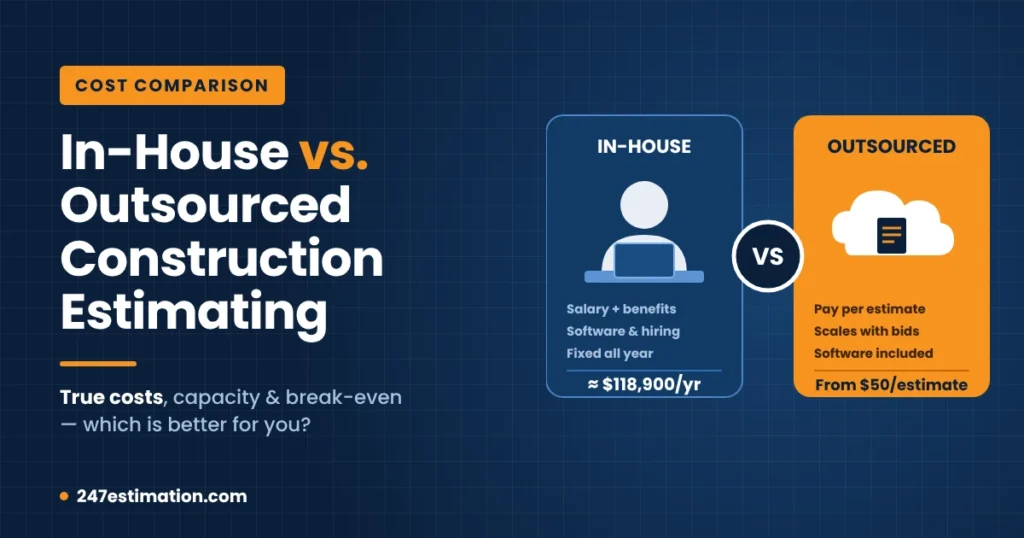
| First-year total | About $118,906 |
That total stays the same whether you bid 40 jobs or 400.
Hidden Costs of In-House Estimating
The table above is the visible cost. These costs rarely show up on a budget line:
- Idle time. Bid flow swings. A salaried estimator costs the same in a slow February as in a packed April.
- Vacancy risk. One estimator is one point of failure. If they quit or get sick, bids stop until you replace them.
- Ramp-up. A new hire needs time to learn your crews, suppliers, markups and file setup. Expect lower output for the first few months.
- Management time. Someone has to review work, set priorities and check numbers.
- Software creep. Licenses renew every year, and price tiers tend to rise.
- Hiring difficulty. In AGC’s 2026 workforce survey of firms with $50 million to $500 million in revenue, about three in four firms with estimating openings said those roles were hard to fill.
How Much One Estimator Can Actually Produce
Cost per estimate depends on how many estimates one person can finish. That depends on job type.
Start with working hours. A full-time year is 2,080 hours. Remove about 18 days of holidays and paid leave, and you have about 1,936 hours. Estimators also spend time on email, meetings, sub calls and admin. If 75% of the rest goes to actual estimating, that leaves about 1,452 estimating hours a year.
The hours per estimate below are our working ranges from day-to-day takeoff work. Your numbers will vary with drawing quality, scope and estimator skill.
| Estimate Type | Typical Hours per Estimate | Estimates One Person Can Finish per Year |
|---|---|---|
| Residential, single trade | 3 to 6 | About 240 to 480 |
| Commercial, 1 to 2 trades | 10 to 20 | About 70 to 145 |
| Residential, full build | 12 to 24 | About 60 to 120 |
| Commercial, full multi-trade | 30 to 60 | About 24 to 48 |
| Large commercial or industrial | 80 to 160 | About 9 to 18 |
This changes the math a lot. One estimator on full commercial bids may finish only 24 to 48 a year. At $118,906, that works out to about $2,500 to $5,000 per estimate in direct cost.
What Outsourced Estimating Costs
Outsourced estimating is a variable cost. You pay for each estimate you order, and nothing during slow months.
Our own rates show the typical range:
| Project Type | Our Price per Estimate |
|---|---|
| Residential, single trade | $50 to $125 |
| Residential, two trades | $100 to $200 |
| Residential, full build | $250 to $400 |
| Commercial, 1 to 2 trades | $200 to $400 |
| Commercial, full build | $300 to $500 |
| 5+ jobs per month | Custom monthly rate |
Software, cost data, training and turnover sit on our side. You pay nothing extra for them.
Hidden Costs of Outsourcing
Outsourcing has its own hidden costs. Plan for them honestly:
- Your review time. Someone in-house still has to check scope, add markup and sign off. Budget an hour or two per estimate.
- Setup time. The first few projects take extra back-and-forth while the vendor learns your preferences.
- Rush fees. Same-day turnarounds may cost more with some vendors.
- Clarification delays. Questions about unclear drawings can slow a bid if the vendor is hard to reach.
- Lost learning. If you only keep the PDF, your company builds no cost history. Always ask for the editable Excel file.
- Tasks not covered. As the earlier table shows, sub outreach, bid strategy and owner meetings usually stay with you.
The Break-Even Point
At what volume does one in-house estimator become cheaper than outsourcing? Using the $118,906 first-year cost:
| Estimates per Year | In-House Cost per Estimate | Outsourced Total at $300 Avg. | Outsourced Total at $450 Avg. |
|---|---|---|---|
| 50 | $2,378 | $15,000 | $22,500 |
| 100 | $1,189 | $30,000 | $45,000 |
| 150 | $793 | $45,000 | $67,500 |
| 200 | $595 | $60,000 | $90,000 |
| 300 | $396 | $90,000 | $135,000 |
| 400 | $297 | $120,000 | $180,000 |
On paper, one estimator breaks even at about 264 estimates a year at a $450 average, or about 396 estimates a year at a $300 average.
Now check that against the capacity table. One person can reach 264+ estimates a year only on small, repeat scopes like single-trade residential work. On full commercial bids, one estimator tops out far below break-even. For takeoff and pricing work alone, outsourcing costs less for most contractors. In-house earns its cost through the other tasks: bid strategy, sub management, owner contact and preconstruction leadership.
Three Real-World Scenarios
These examples use the figures above. Swap in your own bid counts and prices.
Scenario 1: Residential Remodeler
- About 8 full residential estimates a month, or 96 a year
- About 18 hours each, or 1,728 hours a year (about 1.2 full-time estimators)
| Option | Annual Cost |
|---|---|
| Hire one estimator (stretched past capacity) | About $118,906 |
| Outsource all 96 at about $325 | About $31,200 |
Best fit: Outsourced. One hire would still fall behind in busy months, and the cost gap is wide.
Scenario 2: Commercial Subcontractor With Seasonal Swings
- About 240 trade bids a year at about 15 hours each, or 3,600 hours
- Busy months reach 35 bids (about 525 hours). Slow months drop to 5.
- One estimator covers only about 121 hours a month.
| Option | Annual Cost |
|---|---|
| Outsource all 240 at about $250 | About $60,000 |
| One in-house estimator plus outsourced overflow (144 bids) | About $154,906 |
Best fit: Outsourced on cost alone. A hybrid makes sense only if the firm values in-house control enough to pay roughly $95,000 more for it.
Scenario 3: Mid-Size General Contractor
- About 6 full commercial bids a month, or 72 a year, at about 45 hours each
- That is 3,240 hours, or about 2.2 full-time estimators
- Heavy sub outreach, owner meetings and bid strategy
| Option | Annual Cost |
|---|---|
| Two in-house estimators | About $237,812 |
| One in-house lead plus outsourced takeoffs (72 at about $450) | About $151,306 |
Best fit: Hybrid. The lead handles strategy, subs and owners. The outside team handles measuring and pricing. That saves about $86,500 a year compared with two hires.
The Owner’s Time Is a Cost Too
Many small contractors skip both options. The owner does the takeoffs at night.
That time is not free. If an owner spends 10 hours a week on takeoffs and values their time at $100 an hour, that is about $52,000 a year in time not spent selling, managing jobs or walking sites. Use your own rate, but count it.
Side-by-Side Comparison
| Factor | In-House Estimator | Outsourced Estimating |
|---|---|---|
| Cost structure | Fixed salary and benefits | Pay per estimate or monthly plan |
| First-year cost | About $88,000 to $187,000 fully loaded | Scales with the bids you send |
| Startup time | About 6 weeks to hire, then ramp-up | Plans can go out the same day |
| Capacity | Limited to one person’s hours | Scales up for bid peaks |
| Trade coverage | Depends on that person’s skills | Team covers every CSI division |
| Software and cost data | You buy and renew licenses | Included |
| Preconstruction tasks | Covers sub outreach, strategy and meetings | Usually takeoff and pricing only |
| Company knowledge | Builds over time, stays in-house | Vendor learns your preferences |
| Change orders | Fast, sits down the hall | Depends on the vendor’s revision speed |
| Turnover risk | High impact if they leave | Vendor’s problem, not yours |
| Data control | Full | Needs an NDA and clear file handling |
When In-House Estimating Wins
We would rather you hire well than outsource badly. In-house is the stronger choice in these cases:
- Steady, high bid volume. If you produce estimates every day, a salaried estimator gets cheaper per bid.
- Self-performed work. Your own crew production rates are hard to share with an outside team.
- Long-running historical data. In-house estimators sharpen pricing with every finished job.
- Design-build and negotiated work. These need constant contact with owners and designers.
- Heavy preconstruction roles. Sub outreach, bid leveling and owner meetings need someone inside.
- Fast change orders. Someone in the office can turn a revised scope within the hour.
When Outsourcing Wins
Outsourcing is the stronger choice in these cases:
- Uneven bid flow. Two bids one week and nine the next is normal in construction. Fixed salary does not flex.
- Small and mid-size firms. Paying close to $119,000 a year for part-time estimating work strains cash flow.
- New trades or states. You can test a market without hiring for it.
- Bid peaks. Overflow work goes out instead of piling up.
- Owner time. Owners doing their own takeoffs at night can spend that time winning work instead.
- Hiring gaps. BLS projects cost estimator jobs to decline 4% from 2024 to 2034, with about 16,900 openings a year. AGC members report estimating roles among the hardest to fill.
The Hybrid Model
Many of our clients run a hybrid setup. It keeps control in-house and pushes volume work out.
| Task | In-House Lead Estimator | Outsourced Team |
|---|---|---|
| Bid/no-bid decisions | ✓ | |
| Quantity takeoffs | ✓ | |
| Trade pricing and labor rates | Reviews | ✓ |
| Markup, overhead and profit | ✓ | |
| Subcontractor quote leveling | ✓ | Supports |
| Overflow and peak-season bids | ✓ | |
| New-trade or new-state bids | ✓ | |
| Client meetings and negotiation | ✓ |
This setup lets one estimator handle the volume of two or three. The lead keeps judgment calls and relationships. The outside team handles the measuring and counting.
Outsourcing Risks and How to Control Them
Outsourcing has real risks. Each one has a fix if you choose the right partner.
| Risk | What Can Go Wrong | How to Control It |
|---|---|---|
| Quality | Missed scope or wrong quantities | Ask for a sample, check the review process |
| Communication | Questions slow the bid | Pick a firm with one dedicated estimator per project |
| Change orders | Slow or paid revisions | Confirm revision speed and cost up front |
| Data security | Drawings and pricing leak | Sign an NDA before sending plans |
| Local pricing | National averages miss your market | Require zip-code-based labor and material pricing |
| Priority | Your bid sits in a queue | Get turnaround times in writing |
| Lost cost history | Only PDFs come back | Require editable Excel files on every job |
We built our service around these risks. Each project gets one dedicated estimator. A senior reviewer checks every number, and any error above 1% triggers a full re-review. Revisions are unlimited and usually return within 2 to 4 hours. Every package includes an editable Excel file. You can review our sample estimates before you send a single plan.
What to Put in an Outsourcing Agreement
Before you send live bids, get these terms in writing:
| Term | What to Ask For |
|---|---|
| Turnaround | Standard and rush delivery times per project type |
| Revisions | Number of free revisions and how fast they return |
| Deliverables | Editable Excel, marked-up PDFs, CSI-sorted line items |
| Pricing basis | Cost database used and how often it updates |
| Confidentiality | Signed NDA covering drawings and bid numbers |
| File ownership | You own every takeoff and estimate file |
| Point of contact | One named estimator per project |
| Fee structure | Fixed price per estimate, with no surprise hourly billing |
Metrics to Track After You Decide
Whatever model you pick, track these numbers every quarter:
- Estimates per month. Is capacity keeping up with bid invites?
- Cost per estimate. Total estimating spend divided by estimates finished.
- Turnaround time. Days from plan receipt to finished estimate.
- Hit rate. Jobs won divided by bids submitted.
- Estimate-to-actual variance. How close final job costs land to the estimate.
- Missed bids. Invites you passed on for lack of time.
If cost per estimate rises while hit rate drops, your model needs a change.
How to Decide in Five Steps
- Count your bids. Track full estimates per month for the last 12 months.
- Measure the swings. Note your busiest and slowest months.
- Price your in-house option. Use the fully loaded cost for your state, not just salary.
- Price your outsourced option. Multiply your yearly volume by a real per-estimate quote.
- Test before you commit. Outsource two or three live bids and compare accuracy, speed and cost.
A 90-Day Transition Plan
| Phase | What to Do |
|---|---|
| Days 1 to 30 | Send 2 to 3 live bids out. Share your markups, suppliers and crew rates. |
| Days 31 to 60 | Compare outsourced estimates against your own numbers and past job costs. |
| Days 61 to 90 | Decide which bid types stay in-house and which go out. Set up a monthly plan if volume supports it. |
Frequently Asked Questions
Is outsourced estimating accurate? It can be as accurate as in-house work when the firm uses current cost data, proven software and a second review. Our estimates target 95% to 99% accuracy against real project costs.
Can an outsourced estimator learn my pricing? Yes, over time. Share your markups, preferred suppliers and crew rates. A dedicated estimator applies them to every bid.
Does outsourcing replace my estimator? Not always. Many firms keep a lead estimator and outsource takeoffs and overflow. That often costs less than adding a second hire.
How fast can outsourced estimates arrive? Most of our residential and commercial estimates arrive in 24 to 48 hours. Larger jobs take 2 to 4 business days, with rush options.
Who owns the estimate files? You should. Confirm it in writing before you start, and ask for editable Excel files so your cost history stays with you.
What should I send to get started? Send plans in PDF, CAD or BIM format, plus your zip code, scope and bid deadline.
Final Thoughts
In-house estimating pays off when bid volume is high and steady, when work ties closely to your own crew data, and when your estimator also runs preconstruction. Outsourcing pays off when volume swings, cash flow matters or you need coverage fast. For many contractors, the best answer is a hybrid: one strong lead estimator inside, with takeoffs and overflow sent out.
Run your own numbers with the tables above. Then test the outsourced side on a live bid. Our estimating services cover every CSI division in all 50 states, with pricing set to your zip code. Request a quote and see how the numbers compare on your next job.